
No products in the cart.
Return To Shop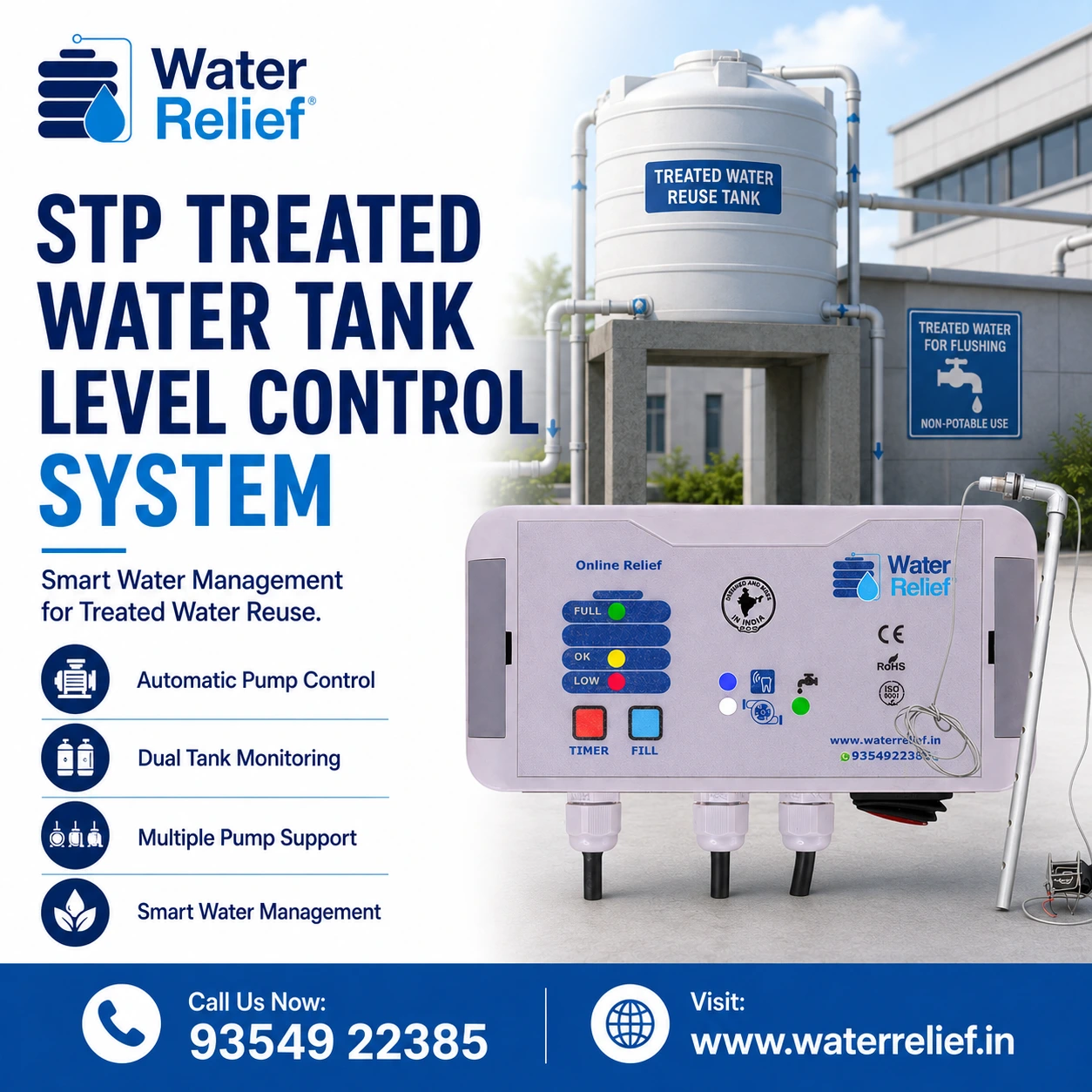
An STP treated water tank level control system helps automatically manage treated wastewater storage, transfer pumps and destination tanks without continuous manual monitoring. It detects water levels inside the tanks and operates pumps according to actual demand.
In apartments, hotels, hospitals, commercial buildings, factories and institutional properties, treated water from a Sewage Treatment Plant (STP) is commonly reused for gardening, toilet flushing, floor cleaning and other approved non-potable applications.
However, managing this treated water manually can be difficult. A tank may overflow, a transfer pump may continue running unnecessarily, or the treated-water tank may become empty while the pump is still operating.
A properly designed Water automation system simplifies this process and helps use treated water more efficiently.
Why STP Treated Water Tanks Need Automatic Level Control
An STP generally treats wastewater continuously or in batches. After treatment, water is stored in a treated-water tank before being pumped to another storage tank or reuse network.
The water level can change throughout the day depending on:
- STP treatment output
- Toilet flushing demand
- Gardening requirements
- Cleaning operations
- Number of occupants
- Pump capacity
- Tank capacity
- Daily water consumption
If the system depends completely on manual pump switching, facility teams must repeatedly inspect the tanks.
Common problems include:
- Treated-water tank overflow
- Destination tank becoming empty
- Pump running when the source tank has insufficient water
- Pumps operating longer than required
- Frequent manual switching
- Unnecessary electricity consumption
- Uneven distribution of treated water
- Difficulty managing multiple tanks and pumps
An Automatic water level controller can reduce these issues considerably.
How an STP Treated Water Tank Level Control System Works
The system uses level sensors installed inside the treated-water and destination tanks.
A typical arrangement may include:
STP → Treated Water Tank → Transfer Pump → Reuse/Overhead Tank → Flushing, Gardening or Cleaning
When the destination tank becomes low, the controller checks whether sufficient treated water is available in the source tank.
If water is available, the pump starts automatically.
Once the destination tank reaches its selected full level, the controller switches off the pump.
The normal sequence is:
Destination tank low → STP tank checked → Water available → Pump starts → Destination tank fills → Full level reached → Pump stops
If the STP treated-water tank becomes too low, the pump is prevented from running until sufficient water becomes available again.
Role of an Automatic Water Level Controller
An Automatic water level controller continuously monitors the selected tank levels.
Depending on the installation, it may detect:
- Low water level
- Normal operating level
- High level
- Tank full condition
- Source tank empty condition
These signals are sent to the control panel, which determines whether the pump should start or stop.
This eliminates the need for maintenance staff to manually check the tank every time water needs to be transferred.
Automatic Water Pump Controller for STP Systems
An Automatic water pump controller connects the tank-level signals with the pump starter or control panel.
It can automate functions such as:
- Pump start
- Pump stop
- Full-tank cut-off
- Low-source-water protection
- Pump status indication
- Manual/automatic operation
- Multiple pump sequencing
The controller needs to be selected according to the pump horsepower, electrical phase, starter type and overall STP arrangement.
Benefits of Automating STP Treated Water Tanks
Prevents Treated Water Overflow
Treated water should be reused effectively rather than allowed to overflow unnecessarily.
When the destination tank reaches the maximum selected level, the controller stops the transfer pump automatically.
This helps reduce:
- Water wastage
- Tank overflow
- Wet plant-room areas
- Drainage load
- Unnecessary pump operation
Improves Treated Water Reuse
STP-treated water can reduce dependence on fresh water for suitable non-potable purposes.
Automation ensures that treated water is transferred when the reuse tank requires it.
As a result, available treated water can be utilised more consistently.
Protects Transfer Pumps
If the treated-water tank becomes empty, a manually operated pump may continue running.
A well-designed control system detects the low source-water level and prevents unsafe pump operation.
This helps reduce the risk of:
- Pump overheating
- Seal damage
- Motor failure
- Frequent repairs
- Unnecessary electricity consumption
Reduces Manual Monitoring
Facility teams already manage multiple systems such as STP operation, electrical panels, pumps and plumbing.
Automatic tank-level control reduces one repetitive task by taking care of routine water transfer.
Saves Electricity
The transfer pump operates only when the destination tank actually needs water.
Once the required level is reached, the controller switches the pump off automatically.
Improves Smart Water Management
Effective Smart water management means using available water sources intelligently rather than relying only on fresh municipal or borewell water.
STP tank automation helps maintain better coordination between treatment, storage and reuse.
Dual Tank Water Level Controller for STP Applications
Many STP installations have at least two important tanks:
- Treated-water collection tank
- Reuse or overhead storage tank
A Dual tank water level controller monitors both tanks together.
The controller starts the pump only when:
- The destination tank requires water, and
- Sufficient treated water is available in the source tank.
It stops the pump when:
- The destination tank becomes full, or
- The treated-water source tank reaches the minimum safe level.
This two-tank logic helps protect the pump while maintaining reliable water transfer.
Water Level Controller for Multiple Pumps
Large properties may have more than one pump for treated-water distribution.
A Water level controller for multiple pumps can be useful where the system has:
- Duty and standby pumps
- Two transfer pumps
- Separate pumps for gardening and flushing
- Multiple overhead tanks
- Separate building blocks
- High water demand
Depending on the system design, the controller can operate pumps according to priority or water demand.
For example, one pump may operate as the primary pump while the second remains on standby. In another arrangement, separate pumps may supply different destination tanks.
STP Automation for Multiple Tanks
Large societies, hotels and commercial projects may use several treated-water tanks.
For example:
- Main STP treated-water tank
- Flushing-water tank
- Gardening-water tank
- Utility tank
- Separate tower tanks
A customised automation system can monitor these tanks and manage water transfer according to priority.
This helps avoid situations where one tank repeatedly fills while another remains short of water.
Suitable Applications
Housing Societies
STP-treated water is commonly reused for flushing, landscaping and common-area cleaning. Automatic tank control reduces the workload on facility teams.
Hotels
Hotels have continuous flushing and landscaping requirements. Automation can help ensure that treated water remains available for designated reuse applications.
Commercial Buildings
Office complexes can reuse treated water for flushing and landscape maintenance while automating transfer between tanks.
Hospitals
Large institutional buildings often have significant water demand. Proper automation can simplify treated-water distribution while keeping potable and non-potable systems clearly separated.
Schools and Colleges
Educational campuses can use treated water for gardens, cleaning and other permitted applications.
Factories and Industrial Properties
Industrial sites may reuse STP-treated water for landscaping, cleaning and suitable utility applications, subject to required treatment quality and local regulations.
Smart Water Management with STP Reuse
A modern Smart water management strategy should consider all available water sources within a property.
Instead of allowing treated water to remain unused, the system can automatically distribute it where appropriate.
A smart arrangement may integrate:
- STP treated-water tank
- Reuse tank
- Multiple pumps
- Multiple destination tanks
- Level sensors
- Automatic valves
- Control panels
- Pump protection
- Manual override
This creates a more organised water-reuse network.
Manual STP Tank Management vs Automatic Control
| Manual Management | Automatic Level Control |
|---|---|
| Requires regular tank checking | Tank levels monitored automatically |
| Higher overflow risk | Stops pump at full level |
| Depends on operators | Reduces manual dependency |
| Pump may run with low source water | Source tank can be monitored |
| Pumps may run unnecessarily | Operates pumps according to demand |
| Difficult with multiple tanks | Supports customised tank control |
| Higher chance of human error | Uses defined control logic |
Important Features to Consider
Before choosing an STP water-level controller, check the complete system rather than selecting a controller based only on tank capacity.
Tank Configuration
Identify the number of source and destination tanks.
Pump Capacity
The controller must be compatible with pump horsepower and electrical load.
Pump Phase
Check whether the pump uses single-phase or three-phase power.
Multiple Pump Control
Large installations may require duty/standby or independent pump operation.
Low-Level Protection
The source tank should be monitored so the transfer pump does not operate without sufficient water.
High-Level Cut-Off
The destination tank should automatically stop receiving water when it reaches the selected maximum level.
Manual Override
Facility teams should still be able to operate the system manually during maintenance and testing.
Clear Status Indicators
Useful indications can include:
- Source tank low
- Source tank full
- Destination tank low
- Destination tank full
- Pump running
- Pump fault
- Automatic/manual mode
Installation Planning for an STP Water Automation System
Before installation, a technician should inspect the complete treated-water network.
Important details include:
- STP treatment capacity
- Treated-water tank capacity
- Destination tank capacity
- Number of tanks
- Number of pumps
- Pump horsepower
- Pump phase
- Starter panel
- Distance between tanks
- Pipe sizes
- Building height
- Daily treated-water generation
- Daily reuse requirement
- Sensor locations
- Existing electrical control system
Correct planning is particularly important when multiple pumps or several destination tanks are involved.
Why Choose Water Relief?
Water Relief provides automatic tank and pump-control solutions for residential, institutional and commercial water-management requirements.
A suitable system can help:
- Automate STP treated-water transfer
- Monitor multiple tanks
- Start and stop pumps automatically
- Prevent unnecessary overflow
- Protect pumps from low-water operation
- Manage multiple pumps
- Reduce manual monitoring
- Improve treated-water utilisation
- Support smarter water management
The appropriate controller should be selected according to the actual tank arrangement, pump specifications and operational requirements.
Visit Water Relief to explore automatic water-management solutions.
Conclusion
An STP treated water tank level control system provides an efficient way to automate the storage and transfer of treated wastewater.
Using an Automatic water level controller and suitable pump control, the system can maintain destination tank levels while avoiding unnecessary pump operation.
For larger installations, a Dual tank water level controller or Water level controller for multiple pumps can coordinate several tanks and pumps according to actual water demand.
A properly designed automation system ultimately makes STP-treated water reuse more reliable, reduces manual work and supports better water conservation.
FAQs
1. What is an STP treated water tank level control system?
It is an automatic system that monitors treated-water tank levels and controls transfer pumps according to the water available in the source and destination tanks.
2. Can an automatic controller prevent STP treated-water tank overflow?
Yes. Full-level sensors can signal the controller to stop the transfer pump when the destination tank reaches the selected maximum level.
3. Can one controller monitor both the STP tank and overhead tank?
Yes. A dual tank water level controller can monitor the source treated-water tank and destination tank together.
4. Can the system operate multiple pumps?
Yes. A suitable controller can be designed for multiple pumps, including duty/standby arrangements or separate pumps serving different tanks.
5. What happens when the STP treated-water tank becomes empty?
The controller can detect the low-water condition and prevent the transfer pump from operating until sufficient water becomes available.
6. Where can an STP water automation system be used?
It can be used in housing societies, hotels, hospitals, offices, schools, institutions, factories and other properties that collect and reuse treated wastewater.
About author

Related posts
A Water automation system for food processing units helps manage storage tanks and pumps without constant manual checking. It monitors water levels, starts the pump... Continue reading
To protect water level controller from rain moisture and insects, the controller should be installed in a dry, covered and properly ventilated location. Direct rain,... Continue reading
A Cooling tower makeup water automation system helps maintain the required water level in cooling tower tanks without constant manual checking. It monitors the water... Continue reading
Greywater recycling tank water automation for buildings helps manage recycled water storage and pump operation without constant manual checking. It monitors tank levels, starts the... Continue reading
Water tank automation for rooftop gardens helps maintain a reliable water supply for plants without constant manual checking. It monitors the tank level, starts the... Continue reading

Add comment