
No products in the cart.
Return To Shop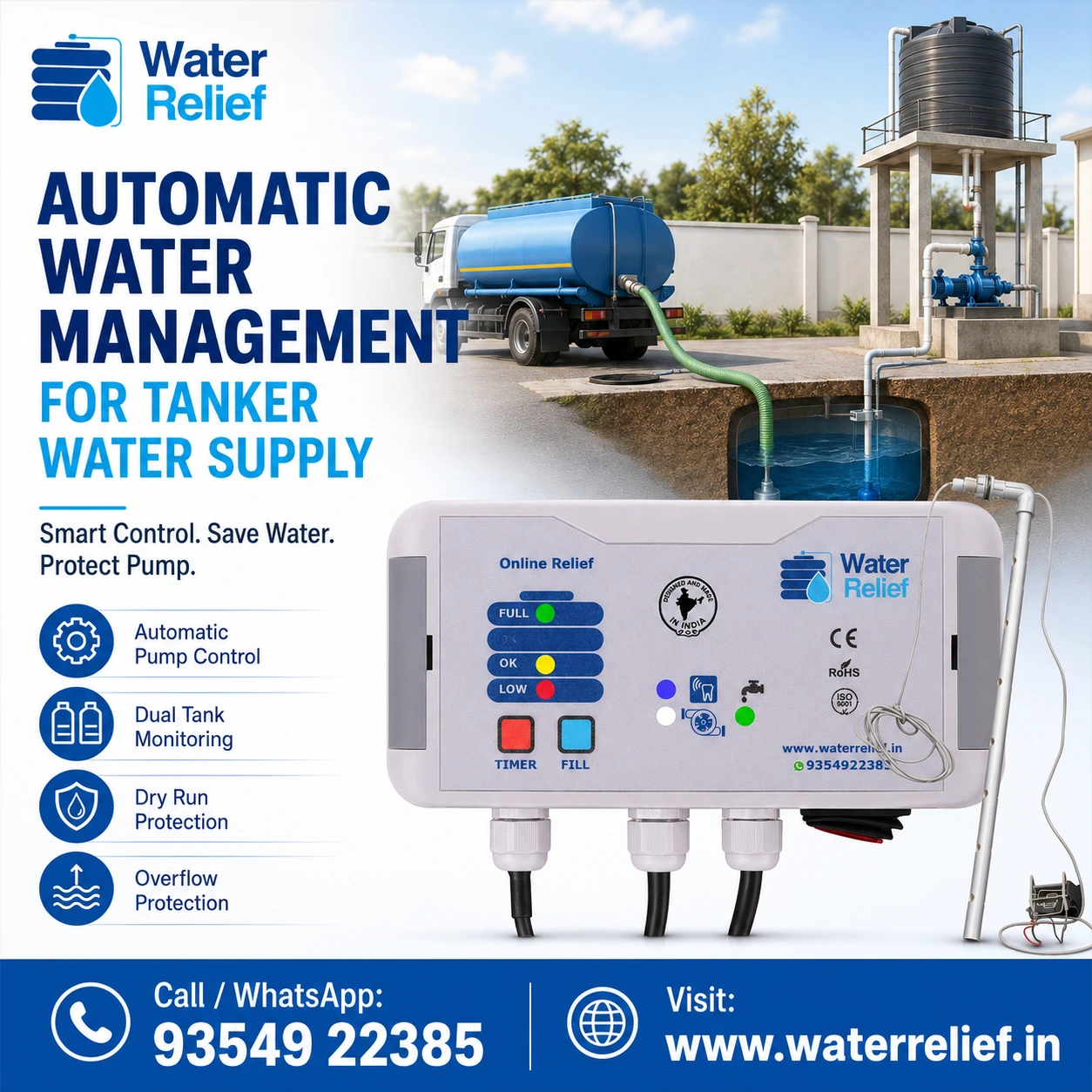
Automatic water management for tanker water supply helps properties receive, store and transfer tanker water without constant manual monitoring. It controls tank filling, pump operation and water movement according to actual tank levels.
Tanker water is commonly used in homes, builder floors, paying guest buildings, societies, offices, schools and commercial properties where municipal supply is limited or irregular. However, manual tanker filling can lead to overflow, missed water delivery, uneven tank filling and unnecessary pump operation.
A properly planned automation system makes the entire process more reliable. It can monitor the underground tank, stop water intake when the tank becomes full and transfer stored water to an overhead tank when required.
Why Tanker Water Supply Needs Automation
Tanker water usually arrives at fixed or uncertain timings. Someone must often remain available to open the inlet, check the tank and stop filling at the right time.
This manual process can create several problems:
- Underground tank overflow
- Tanker water wastage
- Staff forgetting to stop filling
- Pump running without sufficient water
- Overhead tank becoming empty
- Unequal filling of multiple tanks
- Higher electricity use
- Dependence on guards or caretakers
- Frequent resident complaints
- Difficulty managing tanker deliveries at night
Water tanker supply automation reduces these problems by controlling filling and pump operation through sensors.
What Is Water Tanker Supply Automation?
Water tanker supply automation is a system that monitors the water level inside storage tanks and controls pumps or valves automatically.
The system may include:
- Water-level sensors
- Control panel
- Pump starter connection
- Automatic inlet valve
- Tank-full cut-off
- Low-level indication
- Source-tank monitoring
- Manual override
When the underground tank becomes full during tanker delivery, the controller can stop the inlet pump or close an automatic valve. Later, when the overhead tank becomes low, the system can start the transfer pump.
Therefore, tanker water can be received and distributed with less manual effort.
How the System Works
A common tanker-water setup includes one underground storage tank and one overhead tank.
The working process is simple:
Tanker arrives → Underground tank starts filling → Full level detected → Filling stops → Overhead tank becomes low → Transfer pump starts → Overhead tank becomes full → Pump stops
If the underground tank becomes empty, the controller prevents the transfer pump from running.
This complete sequence helps manage both incoming tanker water and internal water distribution.
Role of an Automatic Water Level Controller
An Automatic water level controller monitors the low and full levels of the underground and overhead tanks.
It helps the system determine:
- Whether tanker water can still enter the storage tank
- Whether the underground tank is full
- Whether the overhead tank needs water
- Whether the transfer pump should start
- Whether the pump should stop
- Whether the source tank is empty
As a result, tank filling happens according to actual water levels instead of guesswork.
Role of an Automatic Water Pump Controller
An Automatic water pump controller manages the transfer pump between the underground and overhead tanks.
It can provide:
- Automatic pump start
- Automatic pump stop
- Full-tank cut-off
- Low-level detection
- Source-tank protection
- Pump-running indication
- Manual operation
- Multiple-tank support
The controller must match the pump horsepower, voltage, phase and starter type.
Benefits of Automatic Tanker Water Management
Prevents Underground Tank Overflow
Overflow during tanker filling is one of the most common problems.
A full-level sensor detects when the tank reaches its maximum level. The system then stops the pump or closes the inlet valve.
Therefore, it acts as a reliable Water tank overflow solution.
This helps prevent:
- Water wastage
- Flooding around the tank
- Slippery floors
- Damage to nearby walls
- Extra drainage load
- Loss of paid tanker water
Reduces Dependence on Staff
Manual tanker filling depends on guards, caretakers or residents.
If they are unavailable or distracted, the tank may overflow. Automation reduces this dependency and manages filling through water-level sensors.
Improves Use of Paid Tanker Water
Tanker water has a direct cost. Even a small overflow means financial loss.
Automatic cut-off helps ensure that the delivered water is stored safely and used more efficiently.
Maintains Overhead Tank Supply
The system can automatically transfer water from the underground tank to the overhead tank.
Therefore, residents receive a more consistent supply without manually starting the pump.
Protects the Pump from Dry Running
The transfer pump should not run when the underground tank is empty.
Dry run protection for water pump stops the motor when sufficient source water is unavailable.
This helps reduce:
- Pump overheating
- Mechanical seal damage
- Motor failure
- Repair expenses
- Electricity wastage
Saves Electricity
A manually operated pump may continue running after the overhead tank becomes full.
Automatic control stops the motor immediately. Therefore, electricity is used only when water transfer is required.
Reduces Water Shortage
The system detects when the overhead tank becomes low and starts filling automatically.
This reduces the chances of sudden water shortage in homes, PG buildings, offices and societies.
Dual Tank Water Management
Many properties use two tanks:
- One underground tanker-water storage tank
- One overhead distribution tank
A Dual tank water level controller monitors both tanks together.
It starts the pump only when:
- The overhead tank needs water
- The underground tank has sufficient water
It stops the pump when:
- The overhead tank becomes full
- The underground tank becomes empty
This creates safer and more efficient pump operation.
Water Tank Overflow Solution for Tanker Filling
A dependable Water tank overflow solution is especially important because tanker water is delivered quickly.
The system may use:
- Full-level sensors
- Automatic shut-off valve
- Tanker unloading pump control
- Audible alert
- Status indicators
- Overflow pipe as a backup
Automation should support, not replace, a properly designed overflow pipe.
Automation for Multiple Tanks
Large properties may receive tanker water into one main underground tank and distribute it to several overhead tanks.
A customised system can manage:
- One underground tank and two overhead tanks
- Multiple tenant tanks
- Separate tanks for different floors
- Kitchen and laundry tanks
- Residential and commercial sections
- Main and reserve tanks
The controller can fill tanks according to priority, low-level signals or a fixed sequence.
Suitable Properties
Automatic tanker water management is useful for:
Independent Homes
Homes with irregular municipal supply can store tanker water safely and transfer it automatically.
Builder Floors
Separate floors may use one common underground tank and multiple rooftop tanks.
Paying Guest Buildings
PG properties need continuous water availability for bathrooms, kitchens and laundry.
Housing Societies
Societies can automate tanker unloading and distribution to common storage tanks.
Offices and Commercial Buildings
Commercial properties can reduce dependence on maintenance staff.
Schools and Hostels
Large buildings can manage high water demand more reliably.
Hotels and Guest Houses
Automation helps maintain consistent water availability for rooms, kitchens and housekeeping.
Manual Tanker Filling vs Automatic Management
| Manual Tanker Filling | Automatic Tanker Water Management |
|---|---|
| Requires constant supervision | Works through tank sensors |
| High overflow risk | Stops filling at full level |
| Depends on staff availability | Reduces manual dependency |
| Pump may run dry | Can include dry-run protection |
| Paid water may be wasted | Improves tanker water use |
| Overhead tank may remain empty | Starts transfer automatically |
| Difficult with multiple tanks | Supports multi-tank control |
Features to Check Before Installation
Underground Tank Capacity
The system should be configured according to the actual storage capacity.
Overhead Tank Capacity
The low and full levels should be selected carefully.
Pump Compatibility
The controller must match the pump horsepower, phase, voltage and starter type.
Tanker Filling Method
The technician should check whether the tanker uses:
- Gravity filling
- Tanker-mounted pump
- Property transfer pump
- Automatic inlet valve
Dry Run Protection
The transfer pump should stop when the underground tank becomes empty.
Overflow Protection
The underground and overhead tanks should both have reliable full-level protection.
Manual Override
Manual operation is useful during servicing or emergencies.
Status Indicators
The controller should clearly show:
- Underground tank low
- Underground tank full
- Overhead tank low
- Overhead tank full
- Pump running
- Dry-run condition
- Power availability
Installation Requirements
Before installation, a technician should inspect:
- Tanker inlet point
- Underground tank capacity
- Overhead tank capacity
- Number of tanks
- Pump horsepower
- Pump phase
- Existing starter panel
- Pipe arrangement
- Distance between tanks
- Building height
- Tanker delivery frequency
- Average daily water use
- Municipal water backup
- Borewell backup
- Sensor installation points
Correct planning ensures smooth tanker filling and safer pump operation.
Why Choose Water Relief?
Water Relief provides automatic water-management solutions for homes, builder floors, PG buildings, societies and commercial properties.
A suitable Water Relief system can help:
- Automate tanker water storage
- Prevent tank overflow
- Control transfer pumps
- Protect pumps from dry running
- Manage underground and overhead tanks
- Reduce manual supervision
- Save water and electricity
- Support multiple tanks
- Improve overall water availability
The system can be selected according to the tank arrangement, pump specifications and property requirements.
Conclusion
Automatic water management for tanker water supply provides a practical way to control tanker filling, underground storage and overhead tank supply.
The system monitors tank levels, stops filling when the storage tank becomes full and starts the transfer pump when the overhead tank requires water.
A suitable Automatic water pump controller also protects the motor through Dry run protection for water pump. Moreover, a Dual tank water level controller helps manage the underground and overhead tanks together.
By installing the right automation system, properties can reduce water wastage, protect pumps and use tanker water more efficiently.
FAQs
1. What is automatic water management for tanker water supply?
It is a system that monitors storage tanks and automatically controls tanker filling, transfer pumps and tank cut-off.
2. Can the system stop underground tank overflow?
Yes. A full-level sensor can stop the filling pump or close an automatic inlet valve when the tank becomes full.
3. Can tanker water be transferred to an overhead tank automatically?
Yes. The controller can start the transfer pump when the overhead tank becomes low and stop it when the tank becomes full.
4. What is a dual tank water level controller?
It is a controller that monitors both the source tank and destination tank and operates the pump according to their water levels.
5. Does the system provide dry run protection?
Yes. A suitable controller stops the pump when the underground tank does not contain enough water.
6. Can it work with a tanker-mounted pump?
It may be possible depending on the tanker connection and control method. The complete setup should be inspected before installation.
About author

Related posts
A Water automation system for food processing units helps manage storage tanks and pumps without constant manual checking. It monitors water levels, starts the pump... Continue reading
To protect water level controller from rain moisture and insects, the controller should be installed in a dry, covered and properly ventilated location. Direct rain,... Continue reading
A Cooling tower makeup water automation system helps maintain the required water level in cooling tower tanks without constant manual checking. It monitors the water... Continue reading
Greywater recycling tank water automation for buildings helps manage recycled water storage and pump operation without constant manual checking. It monitors tank levels, starts the... Continue reading
Water tank automation for rooftop gardens helps maintain a reliable water supply for plants without constant manual checking. It monitors the tank level, starts the... Continue reading

Add comment