
No products in the cart.
Return To Shop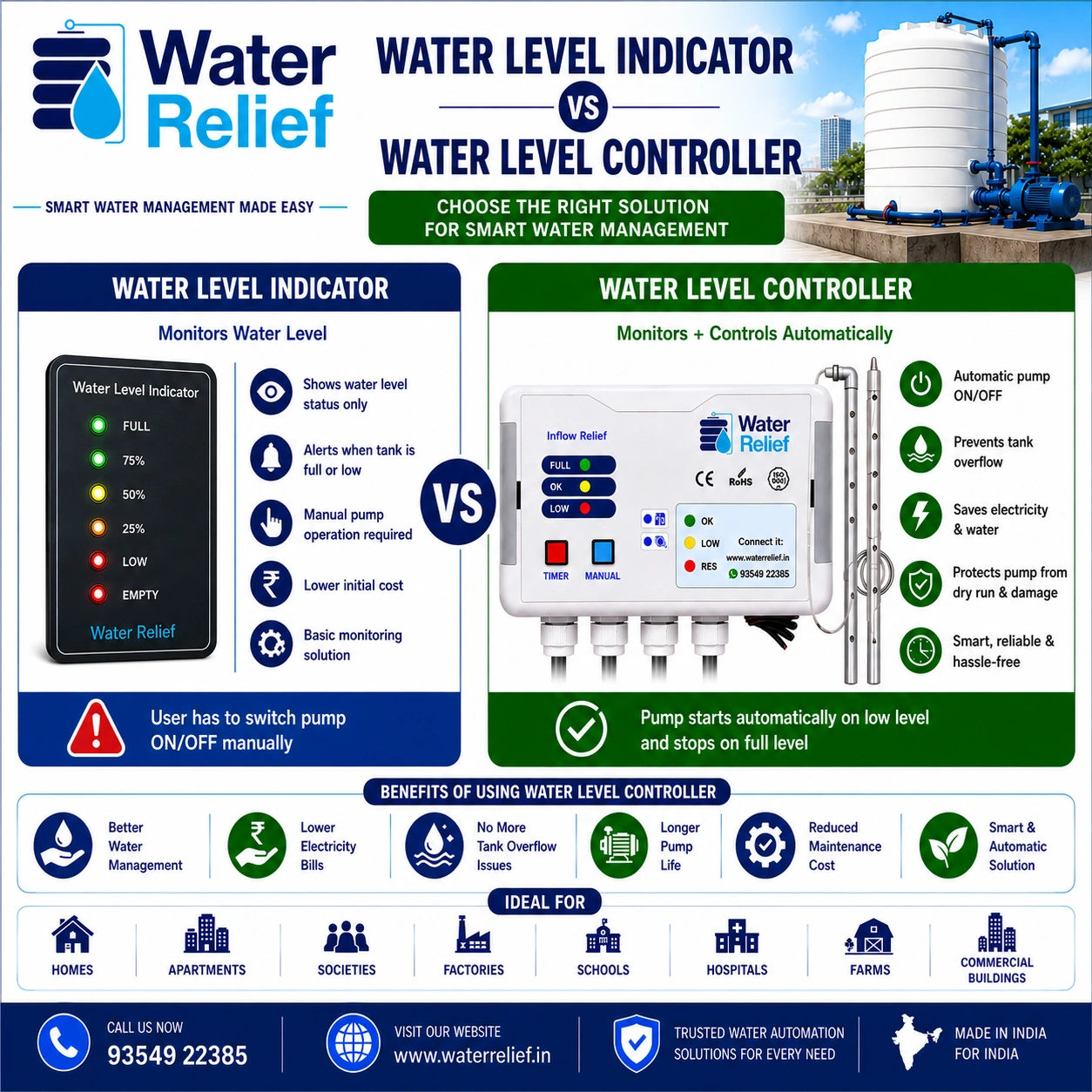
Water management has become an important part of modern homes, apartments, factories, schools, hospitals, and commercial buildings. Manual pump operation often causes water wastage, electricity loss, pump damage, and serious tank overflow issues. To solve these problems, many people install water monitoring and automation systems.
Two of the most common solutions are:
- Water Level Indicator
- Water Level Controller
Many people get confused between these two systems because both are related to water tank management. However, their functions and capabilities are very different. Understanding the difference between a Water Level Indicator vs Water Level Controller helps users choose the right solution for their property.
Water Relief provides advanced automatic water management systems designed to improve water efficiency, automate pump control, and reduce manual monitoring.
What Is a Water Level Indicator?
A Water Level Indicator is a device that shows the water level inside a tank. It helps users understand whether the tank is:
- empty
- low
- half-filled
- nearly full
- full
The main purpose of a water level indicator is monitoring.
It gives information about tank water levels but does not automatically control the water pump.
How a Water Level Indicator Works
A water level indicator uses sensors inside the tank to detect water levels.
When water reaches different points, the indicator displays the level through:
- LED lights
- alarms
- display units
Some systems also include a Water Tank Alarm System that alerts users when the tank becomes full or low.
However, the user still needs to manually switch the pump ON or OFF.
Advantages of Water Level Indicator
1. Simple Monitoring
Users can easily check tank water status.
2. Helps Reduce Overflow Risk
Users receive alerts before overflow happens.
3. Basic Water Awareness
It improves understanding of daily water usage.
4. Lower Initial Cost
Basic indicators are usually more affordable.
Limitations of Water Level Indicator
Although indicators are useful, they have several limitations.
Manual Pump Operation Required
The biggest limitation is that the user must manually control the pump.
Human Dependency
If someone forgets to switch OFF the pump, overflow may still occur.
No Pump Protection
Indicators usually do not protect the motor from dry running or overheating.
Limited Automation
They provide information only, not automation.
What Is a Water Level Controller?
A Water Level Controller is a smart automation device that automatically controls water pump operation based on tank levels.
It performs both:
- water level monitoring
- automatic pump control
When water level becomes low, the controller starts the motor automatically.
When the tank becomes full, the controller stops the motor automatically.
This creates a complete Automatic Water System.
Water Relief provides advanced controllers suitable for homes, apartments, factories, schools, hospitals, and commercial buildings.
How a Water Level Controller Works
A controller continuously monitors water levels through sensors.
Low Water Level:
- pump turns ON automatically
Full Tank:
- pump turns OFF automatically
This automation removes the need for manual monitoring.
Some advanced controllers also support:
- dry run protection
- overflow prevention
- alarm systems
- smart monitoring
Advantages of Water Level Controller
1. Fully Automatic Operation
The controller automatically manages pump ON/OFF operation.
2. Prevents Tank Overflow Issues
Automatic shutoff prevents water wastage.
3. Saves Electricity
Pumps run only when required.
4. Protects Pump Life
Controllers reduce dry running and overuse.
5. Reduces Manual Effort
No need for continuous monitoring.
6. Better Smart Water Management
Controllers improve overall water efficiency.
Water Level Indicator vs Water Level Controller: Main Difference
The main difference is simple:
| Feature | Water Level Indicator | Water Level Controller |
|---|---|---|
| Shows Water Level | Yes | Yes |
| Automatic Pump Control | No | Yes |
| Prevents Overflow Automatically | No | Yes |
| Saves Electricity | Limited | Yes |
| Pump Protection | No | Yes |
| Manual Monitoring Required | Yes | Minimal |
| Smart Automation | Basic | Advanced |
Which System Is Better?
For modern properties, a Water Level Controller is usually the better choice because it offers complete automation.
A controller not only monitors water but also:
- controls pumps automatically
- prevents overflow
- protects pumps
- improves efficiency
This makes controllers more practical for long-term use.
Why Automatic Water Management Systems Are Important
Modern buildings require smarter water management.
automatic water management systems help:
- reduce water wastage
- improve pump efficiency
- automate operations
- reduce maintenance dependency
- improve water availability
Water Relief focuses on providing practical automation solutions for Indian conditions.
Silent Water Controller for Better Performance
A Silent Water Controller provides smooth and efficient operation with minimal disturbance.
Benefits include:
- quiet motor switching
- smooth operation
- reduced pump stress
- reliable performance
For homes, schools, hospitals, and offices, silent operation improves convenience.
Smart Water Management for Modern Buildings
Smart Water Management has become essential for:
- homes
- apartments
- factories
- schools
- hospitals
- commercial buildings
Automation improves efficiency while reducing manual errors.
Water Tank Alarm System vs Controller
A Water Tank Alarm System only alerts users about water levels.
A controller goes further by automatically controlling the pump.
This is why automation systems are more effective for preventing overflow and saving electricity.
Role of Submersible Pump Controller
Many buildings use borewell or underground water systems.
A Submersible Pump Controller helps protect submersible pumps from:
- dry running
- overheating
- unnecessary operation
Water Relief controllers support better pump safety and efficiency.
Why Water Relief Is a Better Choice
Water Relief offers reliable and advanced water automation systems designed specifically for Indian conditions.
Key advantages include:
- automatic pump ON/OFF
- overflow prevention
- smart tank monitoring
- pump protection
- easy installation
- low maintenance
These features make Water Relief suitable for homes, apartments, schools, factories, hospitals, and commercial buildings.
Suitable Applications of Water Level Controllers
Water Relief systems can be used in:
- independent houses
- apartments
- villas
- schools
- colleges
- hospitals
- factories
- societies
- commercial buildings
They support:
- overhead tanks
- underground tanks
- borewell systems
- municipal supply systems
Long-Term Benefits of Water Automation
Using a Water Level Controller helps reduce:
- water wastage
- electricity bills
- pump repair costs
- maintenance expenses
Over time, automation becomes more cost-effective than manual systems.
Future of Smart Water Automation
As water scarcity increases, automation will become increasingly important.
Smart systems improve:
- water conservation
- operational efficiency
- infrastructure reliability
- sustainability
Water Relief supports smarter water management through practical automation technology.
Final Thoughts
Understanding the difference between Water Level Indicator vs Water Level Controller is important before choosing a water management system.
A Water Level Indicator helps monitor water levels, while a Water Level Controller provides complete automation and pump control.
For better Smart Water Management, overflow prevention, electricity savings, and pump protection, a Water Level Controller is the smarter and more reliable choice.
With advanced automatic water management systems, Silent Water Controller technology, and smart automation features, Water Relief provides efficient solutions for modern water management needs.
About author

Related posts
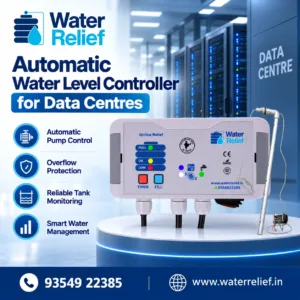
An Automatic Water Level Controller for data centres helps manage water storage tanks and pump operation without repeated manual checking. It monitors tank levels, starts... Continue reading
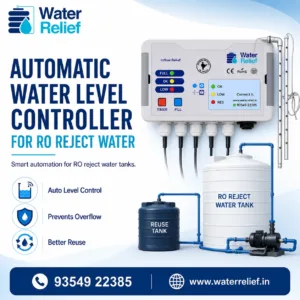
An Automatic water level controller for RO reject water helps monitor reject-water tanks and control pumps without repeated manual checking. It detects tank levels, starts... Continue reading
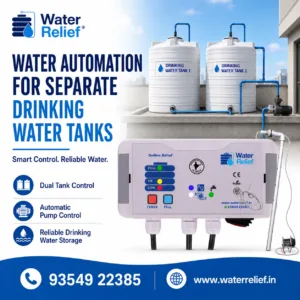
Water automation for separate drinking water tanks helps manage multiple potable-water storage tanks without constant manual checking. The system monitors tank levels, starts the pump... Continue reading
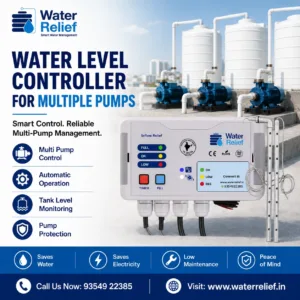
A Water Level Controller for Multiple Pumps is a smart solution for buildings, societies, factories, hotels, schools, hospitals and commercial spaces where more than one... Continue reading
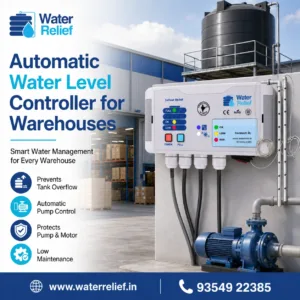
Automatic Water Level Controller for Warehouses is a smart solution for commercial spaces that need regular water supply. Warehouses use water for cleaning, staff washrooms,... Continue reading

Add comment