
No products in the cart.
Return To Shop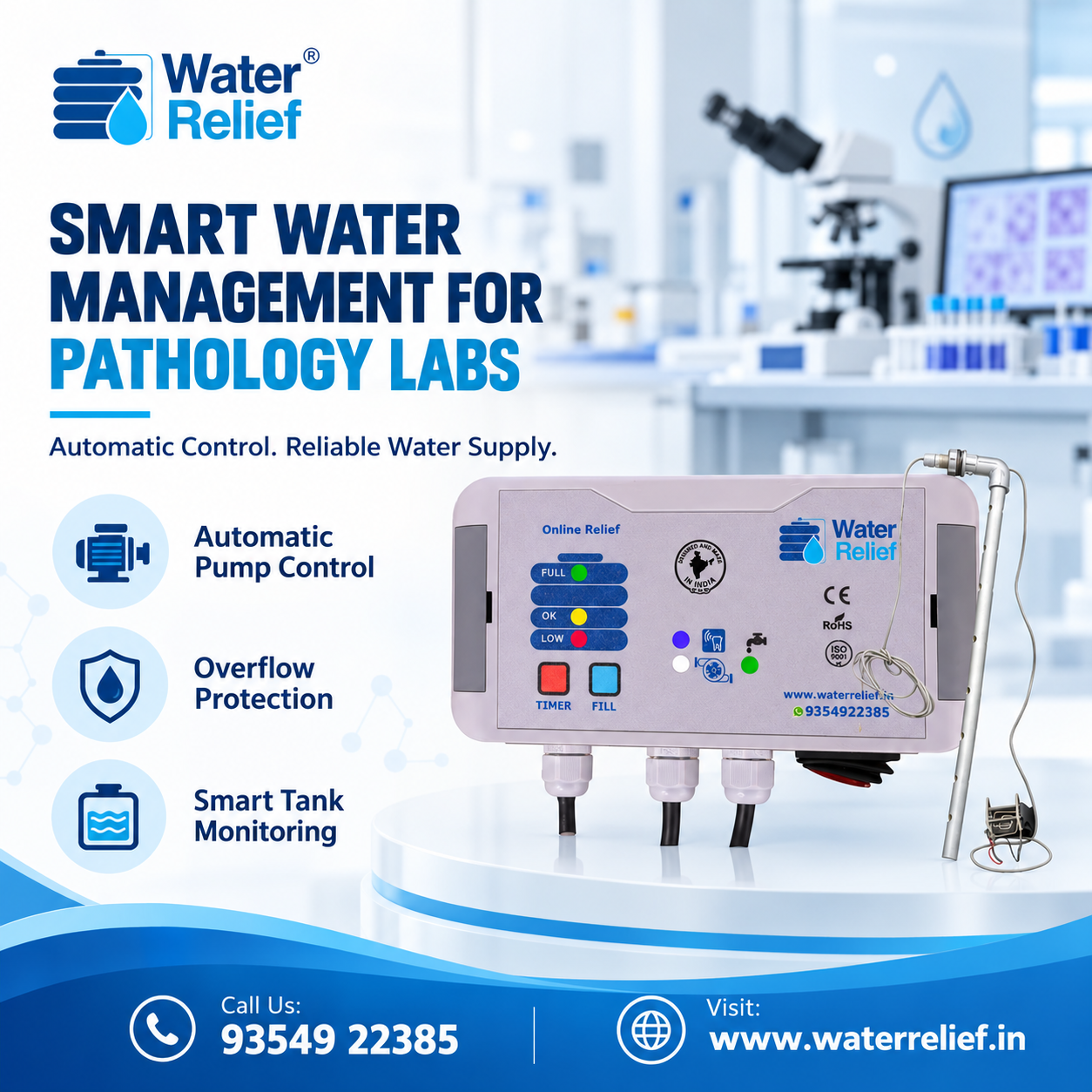
Smart Water Management for Pathology Labs helps maintain a reliable water supply for daily diagnostic and laboratory operations. Pathology labs depend on water for handwashing, cleaning, sanitation, washrooms, sample-processing support, housekeeping, and general utility use.
Because water demand may continue throughout the day, manual tank monitoring can become inconvenient. Therefore, a properly planned Water automation system can help monitor tank levels, control pumps automatically, and reduce unnecessary overflow.
Why Pathology Labs Need Smart Water Management
Pathology labs must maintain clean and well-managed working areas.
Water may be required for:
- Handwashing
- Laboratory cleaning
- Washroom use
- Floor cleaning
- Equipment-area cleaning
- Utility sinks
- Staff facilities
- General housekeeping
If the water tank becomes empty unexpectedly, regular operations may be affected.
As a result, Smart Water Management for Pathology Labs can help improve daily water availability.
How Smart Water Management Works
The system monitors water levels inside the tank and operates the pump according to actual demand.
A typical process may work like this:
Tank level becomes low → Pump starts → Tank fills → Full level reached → Pump stops
This reduces dependence on manual pump switching.
Role of an Automatic Water Level Controller
An Automatic water level controller monitors the tank continuously.
It can detect conditions such as:
- Low water level
- Normal water level
- Full tank level
These signals help the system decide when the pump should start or stop.
Therefore, the tank can maintain a more suitable water level without repeated manual checking.
Automatic Water Pump Controller for Pathology Labs
An Automatic water pump controller helps manage pump operation automatically.
Depending on the installation, it may support:
- Automatic pump start
- Automatic pump stop
- Full tank cut-off
- Pump-running indication
- Manual override
- Tank-level status
The controller should match the pump horsepower, phase, voltage, and existing starter arrangement.
Water Pump Controller for Diagnostic Facilities
A suitable Water pump controller can help manage pumps supplying water to:
- Pathology laboratories
- Diagnostic centres
- Sample collection centres
- Clinical labs
- Imaging facilities
- Small healthcare centres
- Laboratory washrooms
- Staff utility areas
Proper pump control can help reduce repeated manual switching.
Water Automation System for Laboratory Buildings
A Water automation system can combine tank monitoring and pump control into one organised setup.
For example:
Main water source → Storage tank → Pump → Overhead tank → Laboratory areas
In larger diagnostic buildings, separate tanks may supply different floors or utility zones.
Automation can help manage these tanks according to actual water demand.
Smart Water Systems for Pathology Labs
Smart Water Systems help make tank filling and pump control more organised.
A suitable setup may support:
- Automatic tank filling
- Automatic pump cut-off
- Tank-level monitoring
- Multiple tank control
- Manual operation when needed
As a result, facility teams can spend less time checking tanks manually.
Water Tank Overflow Controller
A Water tank overflow controller helps stop the pump automatically when the tank reaches the selected full level.
This can help reduce:
- Water wastage
- Tank overflow
- Wet utility areas
- Unnecessary pump runtime
- Extra manual supervision
For pathology labs with rooftop or hidden utility tanks, this can be especially useful.
Water Management for Laboratory Cleaning
Cleaning is an important part of daily lab operations.
Water may be required for:
- Work-area cleaning
- Utility sinks
- Washroom cleaning
- Floor cleaning
- General housekeeping
Therefore, maintaining reliable tank levels helps support routine hygiene and maintenance activities.
Water Management for Staff and Patient Areas
Pathology labs may also have:
- Reception areas
- Waiting areas
- Staff rooms
- Washrooms
- Sample collection rooms
These spaces require regular water access.
An automated system helps support these shared areas without repeated pump monitoring.
Water Management for Multi-Floor Diagnostic Centres
Some pathology labs operate across multiple floors.
For example:
- Ground floor reception
- Sample collection floor
- Testing laboratory
- Staff area
- Utility floor
A customised system can support separate tanks or water zones depending on the building layout.
Multiple Tank Management
Larger diagnostic centres may use more than one tank.
These may include:
- Underground tank
- Overhead tank
- Utility tank
- Reserve tank
- Separate floor tank
A properly designed Water automation system can help manage these tanks according to their individual requirements.
Benefits of Smart Water Management for Pathology Labs
Automatic Tank Filling
The pump can start automatically when the tank reaches a low level.
Automatic Pump Cut-Off
The pump stops when the tank reaches the selected full level.
Reduced Manual Monitoring
Staff do not need to inspect water tanks repeatedly.
Reduced Overflow Risk
A Water tank overflow controller helps reduce unnecessary water wastage.
Better Water Availability
Automatic tank filling helps support daily lab and sanitation needs.
Better Pump Management
An Automatic water pump controller operates according to actual tank demand.
Smart Water Management During Peak Hours
Pathology labs may experience higher activity during:
- Morning sample collection
- Health check-up camps
- Corporate testing schedules
- Weekend testing
- Seasonal diagnostic demand
During these periods, water use may rise.
Automation helps the system respond to actual tank levels instead of relying only on manual operation.
Suitable Locations for This System
Smart water automation can be useful for:
- Pathology labs
- Diagnostic centres
- Sample collection centres
- Clinical laboratories
- Medical testing facilities
- Imaging centres
- Multi-speciality diagnostic units
Each facility should be assessed according to its actual tank, pump, and water-use requirements.
Features to Check Before Installation
Tank Capacity
The system should match the size and number of tanks.
Pump Horsepower
The controller must support the actual pump load.
Pump Phase
Check whether the pump is single-phase or three-phase.
Full Tank Cut-Off
The pump should stop automatically once the selected full level is reached.
Multiple Tank Support
Larger diagnostic centres may require control for more than one tank.
Manual Override
Manual operation can be useful during maintenance and testing.
Status Indicators
Useful indications may include:
- Tank low
- Tank full
- Pump running
- Power available
- Automatic mode
- Manual mode
Installation Requirements
Before installation, a technician should inspect:
- Number of tanks
- Tank capacities
- Pump horsepower
- Pump phase
- Existing starter panel
- Water source
- Number of floors
- Daily water demand
- Pipe layout
- Sensor positions
Therefore, proper site inspection is important before selecting the final controller.
Why Choose Water Relief?
Water Relief provides automatic tank and pump-control solutions for residential, commercial, institutional, and suitable healthcare-related applications.
A properly selected system can help:
- Automate tank filling
- Start and stop pumps automatically
- Reduce manual monitoring
- Reduce tank overflow
- Improve water availability
- Support multiple tanks
- Improve pump operation
- Support smarter daily water management
The system should always be selected according to tank size, pump specifications, building layout, and actual water demand.
Conclusion
Smart Water Management for Pathology Labs can help maintain reliable water availability while reducing repeated manual pump operation.
An Automatic water level controller monitors tank conditions, while an Automatic water pump controller manages pump operation according to actual demand.
With the right Water automation system, Water pump controller, Smart Water Systems, and Water tank overflow controller, pathology labs can manage water more efficiently and reduce unnecessary overflow.
FAQs
1. What is Smart Water Management for Pathology Labs?
It is an automated system that monitors tank levels and controls pumps according to the water demand of the laboratory.
2. Can the pump start automatically when the tank is low?
Yes. An automatic water level controller can detect low water levels and activate the pump according to the configured setup.
3. Can the system stop the pump when the tank is full?
Yes. A water tank overflow controller can stop the pump automatically at the selected full level.
4. Is this suitable for diagnostic centres with multiple floors?
Yes. A customised system can be planned for multiple tanks, floors, or utility zones.
5. Can this system reduce manual tank checking?
Yes. Automatic monitoring and pump control can significantly reduce repeated manual checking.
6. Is professional installation recommended?
Yes. A technician should inspect the tanks, pumps, starter panel, water source, and building layout before installation.
About author

Related posts
Automatic Water Level Controller in Sohna Road Gurgaon by Water Relief helps automate water tank filling and pump operation for apartments, housing societies, builder floors,... Continue reading
Automatic Water Level Controller in Dwarka Delhi by Water Relief helps automate water tank filling and pump operation for homes, apartments, builder floors, villas, societies,... Continue reading

Water Relief Smart Water Management for Sports Complexes Smart Water Management for Sports Complexes by Water Relief helps automate water tank filling and pump operation... Continue reading

Smart Water Systems for Sweet Manufacturing Units help automate tank filling and pump operation in mithai factories, sweet production units, commercial kitchens, and food-processing facilities.... Continue reading
Municipal Water Supply Automatic Water Level Controller helps automate tank filling and pump operation in public water supply systems, municipal facilities, community storage tanks, and... Continue reading

Add comment