
No products in the cart.
Return To Shop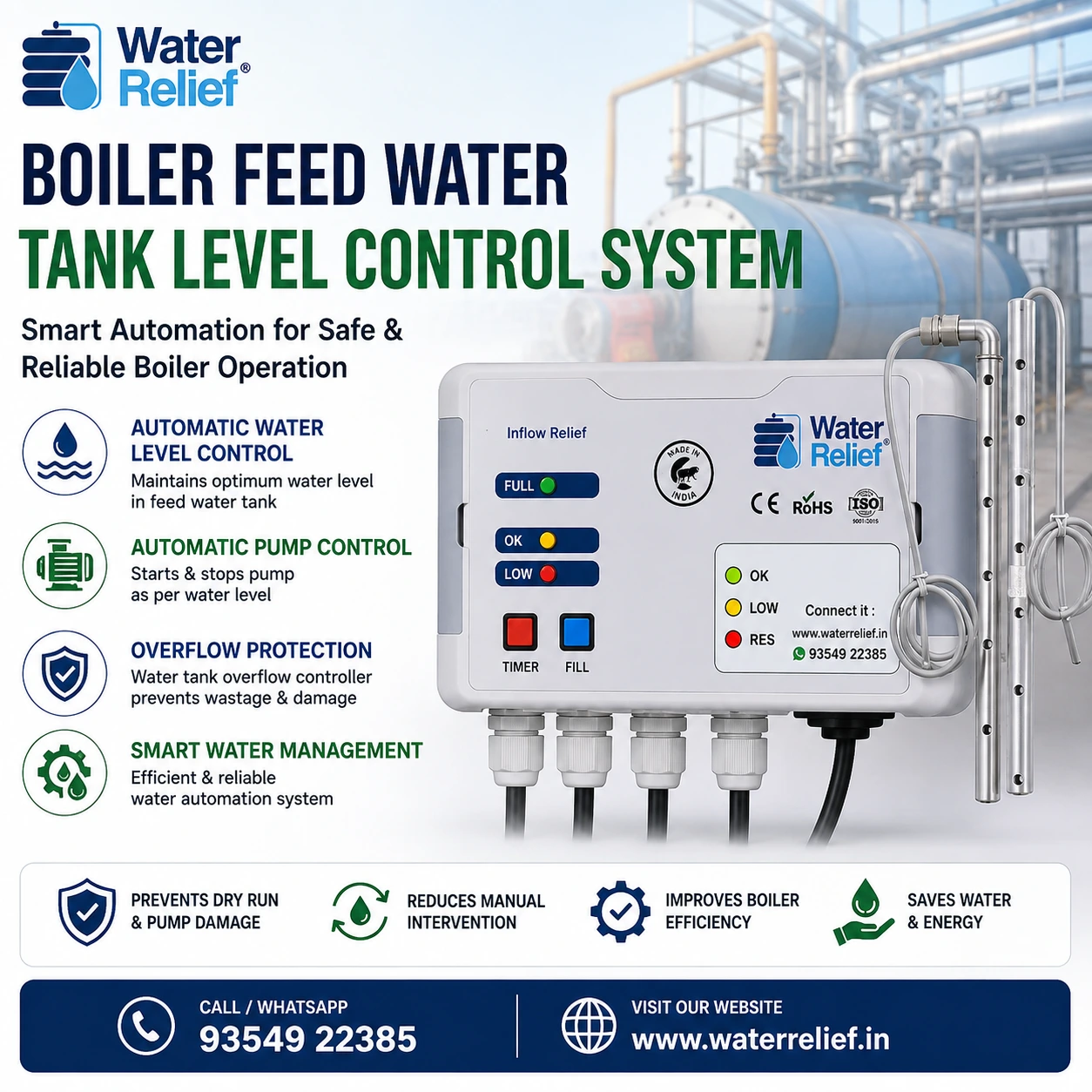
A Boiler Feed Water Tank Level Control System helps maintain the required water level in the boiler feed tank without constant manual checking. It monitors the tank level and controls the connected pump according to actual water demand.
In industrial plants, boiler systems depend on a steady supply of feed water. Therefore, a low tank level can affect boiler operation, while overfilling the tank can waste water and create avoidable site issues.
A properly planned Boiler water level control system helps reduce these problems. It supports automatic filling, pump control and better day-to-day water management around the boiler feed system.
Why Boiler Feed Water Tanks Need Automatic Level Control
Boiler feed tanks are an important part of many industrial steam systems. They store water before it is supplied to the boiler.
The water level inside the tank can change because of:
- Boiler steam demand
- Condensate return
- Fresh make-up water
- Pump flow
- Production load
- Maintenance activity
If the level falls too low, the feed pump may not receive enough water. On the other hand, if the tank keeps filling after it is full, water can overflow.
Therefore, an Automatic water level controller can help maintain a more stable operating level.
How a Boiler Water Level Control System Works
A typical boiler feed water setup may include:
Water Source → Feed Water Tank → Feed Pump → Boiler
Level sensors are installed inside the feed water tank at selected points.
When the tank reaches the low level, the controller can start the filling pump or open the water supply. Once the selected full level is reached, the controller stops the filling process.
The basic sequence is:
Tank low → Water required → Pump starts → Tank fills → Full level reached → Pump stops
As a result, the tank can maintain a more reliable water level without repeated manual operation.
Role of an Automatic Water Level Controller
An Automatic water level controller monitors the feed water tank continuously.
Depending on the system, it may detect:
- Low level
- Normal level
- High level
- Full tank condition
These signals help the controller decide when the pump should start or stop.
Therefore, operators do not need to check the tank repeatedly during normal operation.
Role of an Automatic Water Pump Controller
An Automatic water pump controller connects the level sensors with the pump starter or control panel.
It can manage:
- Automatic pump start
- Automatic pump stop
- High-level cut-off
- Low-level detection
- Pump-running indication
- Manual override
- Multiple pump support
However, the controller should always be matched with the pump horsepower, voltage, electrical phase and starter type.
Benefits of a Boiler Feed Water Tank Level Control System
Maintains a Stable Feed Water Level
Boiler systems need a dependable water supply.
Automatic level control helps keep the tank within the selected range. Therefore, the feed pump can receive water more consistently.
Reduces Manual Monitoring
Industrial operators already manage several systems at the same time.
Automatic tank control reduces the need to check the feed water tank again and again. As a result, staff can focus on other plant operations.
Prevents Tank Overflow
A Water tank overflow controller stops the filling process when the tank reaches the selected full level.
This helps reduce:
- Water wastage
- Wet plant-room areas
- Extra drainage load
- Unnecessary pump operation
- Repeated manual intervention
Improves Pump Operation
A pump should run only when water transfer is required.
Automatic control starts and stops the pump according to actual tank level. Therefore, unnecessary pump run time can be reduced.
Supports Smart Water Management
Smart water management means using water according to actual plant demand.
By automating the feed tank, the system can reduce overflow, improve pump use and simplify daily water handling.
Water Automation System for Boiler Plants
A Water automation system can manage more than one part of the boiler water arrangement.
Depending on the plant, it may include:
- Raw water tank
- Treated water tank
- Feed water tank
- Condensate tank
- Make-up water tank
- Transfer pumps
- Feed pumps
A customised control system can monitor these tanks and manage water transfer according to the plant layout.
Boiler Feed Tank with Condensate Return
Many boiler systems return condensate back to the feed water tank.
Because condensate return can change during the day, the tank level may rise and fall often.
Automatic level control helps balance:
- Condensate return
- Fresh make-up water
- Boiler water demand
As a result, tank filling can be managed more smoothly.
Water Tank Overflow Controller for Boiler Feed Tanks
A Water tank overflow controller is useful where the feed tank receives water continuously or at variable flow rates.
The controller can stop the inlet pump or valve when the tank becomes full.
This is especially useful when:
- Condensate return is high
- Make-up water is automatic
- The feed tank is located away from the operator
- Plant operation continues for long hours
- Several tanks are connected
Smart Water Management in Industrial Boiler Systems
Modern industrial sites aim to reduce water and energy wastage.
A suitable Smart water management setup can help by monitoring tank levels and controlling pumps more efficiently.
This may include:
- Automatic tank filling
- High-level cut-off
- Low-level indication
- Pump status
- Manual mode
- Multiple tank monitoring
Therefore, automation supports a more organised boiler water system.
Features to Check Before Installation
Tank Capacity
The controller should be configured according to the feed tank size.
Pump Capacity
The pump controller must match the motor horsepower and electrical load.
Electrical Phase
Check whether the pump uses single-phase or three-phase power.
High-Level Cut-Off
The filling process should stop automatically when the tank reaches the selected maximum level.
Low-Level Detection
The system should detect low water before the tank becomes critically empty.
Manual Override
Manual mode is useful during maintenance and testing.
Clear Status Indicators
Useful indicators may include:
- Tank low
- Tank high
- Tank full
- Pump running
- Power available
- Manual or automatic mode
Installation Requirements
Before installation, a technician should inspect the complete boiler water system.
Important details include:
- Boiler capacity
- Feed water tank capacity
- Water source
- Condensate return
- Make-up water arrangement
- Pump horsepower
- Pump phase
- Existing starter panel
- Pipe layout
- Tank location
- Sensor positions
- Operating schedule
- Multiple pump requirement
Therefore, proper planning is important before selecting the controller.
Why Choose Water Relief?
Water Relief provides automatic tank and pump-control solutions for residential, commercial, institutional and suitable industrial water-management applications.
A properly selected system can help:
- Automate feed water tank filling
- Start and stop pumps automatically
- Prevent tank overflow
- Reduce manual checking
- Support multiple tanks
- Improve pump operation
- Reduce unnecessary water loss
- Support smarter water management
The controller should be selected according to the tank arrangement, pump specifications and site requirements.
Conclusion
A Boiler Feed Water Tank Level Control System helps maintain a stable water level while reducing manual pump operation and overflow risk.
An Automatic water level controller monitors the tank, while an Automatic water pump controller manages the filling pump according to actual water demand.
With the right Water automation system, industrial plants can improve feed water handling, reduce unnecessary pump operation and support better Smart water management.
FAQs
1. What is a boiler feed water tank level control system?
It is an automatic system that monitors the water level in a boiler feed tank and controls the filling pump or inlet according to the selected level.
2. Can the controller stop boiler feed tank overflow?
Yes. A full-level sensor can stop the filling pump or valve when the tank reaches the selected maximum level.
3. Can the system work with condensate return?
Yes. The controller can manage tank filling while the feed tank also receives condensate return.
4. Can one controller manage multiple pumps?
Yes. A suitable system can be designed for multiple pumps depending on the plant setup.
5. Does the controller reduce manual work?
Yes. It automatically monitors tank levels and controls the filling process, so operators do not need to check the tank continuously.
6. Is professional installation recommended?
Yes. A technician should inspect the feed tank, pump, starter panel, condensate return and water source before installation.
About author

Related posts
A Water automation system for food processing units helps manage storage tanks and pumps without constant manual checking. It monitors water levels, starts the pump... Continue reading
To protect water level controller from rain moisture and insects, the controller should be installed in a dry, covered and properly ventilated location. Direct rain,... Continue reading
A Cooling tower makeup water automation system helps maintain the required water level in cooling tower tanks without constant manual checking. It monitors the water... Continue reading
Greywater recycling tank water automation for buildings helps manage recycled water storage and pump operation without constant manual checking. It monitors tank levels, starts the... Continue reading
Water tank automation for rooftop gardens helps maintain a reliable water supply for plants without constant manual checking. It monitors the tank level, starts the... Continue reading

Add comment